



A New Era for the Shopping Journey
Consumer behaviour is undergoing one of its most profound shifts in a decade. Shoppers are more informed, more time-conscious, and more empowered than at any previous point in the history of retail.
And behind the scenes, artificial intelligence is quietly doing work that once required a store visit, researching products, comparing prices, and in some cases, completing the purchase entirely. According to McKinsey and ICSC's landmark 2026 report based on a survey of more than 3,000 US consumers, it is a structural transformation and not a passing trend.
While the research is rooted in the US market, its conclusions resonate far beyond. India's retail landscape is experiencing its own rapid transformation, driven by a young, digitally native population, the growth of quick commerce, and an increasingly AI-savvy consumer class. For Indian retailers and real estate companies that house them, the lessons here are not merely interesting, they are urgent.

AI, rising consumer expectations, and a new generation with different rules are rewriting retail from the ground up - and the clock is ticking.
Three Forces Driving the Transformation
The first, and arguably most disruptive, is the growing role of AI in everyday purchasing decisions. Today, most shoppers use AI tools early in their journey: researching options, comparing prices, or reading reviews. As trust in these tools grows, consumers are expected to hand over complex tasks to AI agents - from building grocery lists to triggering automatic reorders of household staples. When AI handles the research and the transaction, the physical store's role thus pivots to a place of validation, fulfilment, or experience.
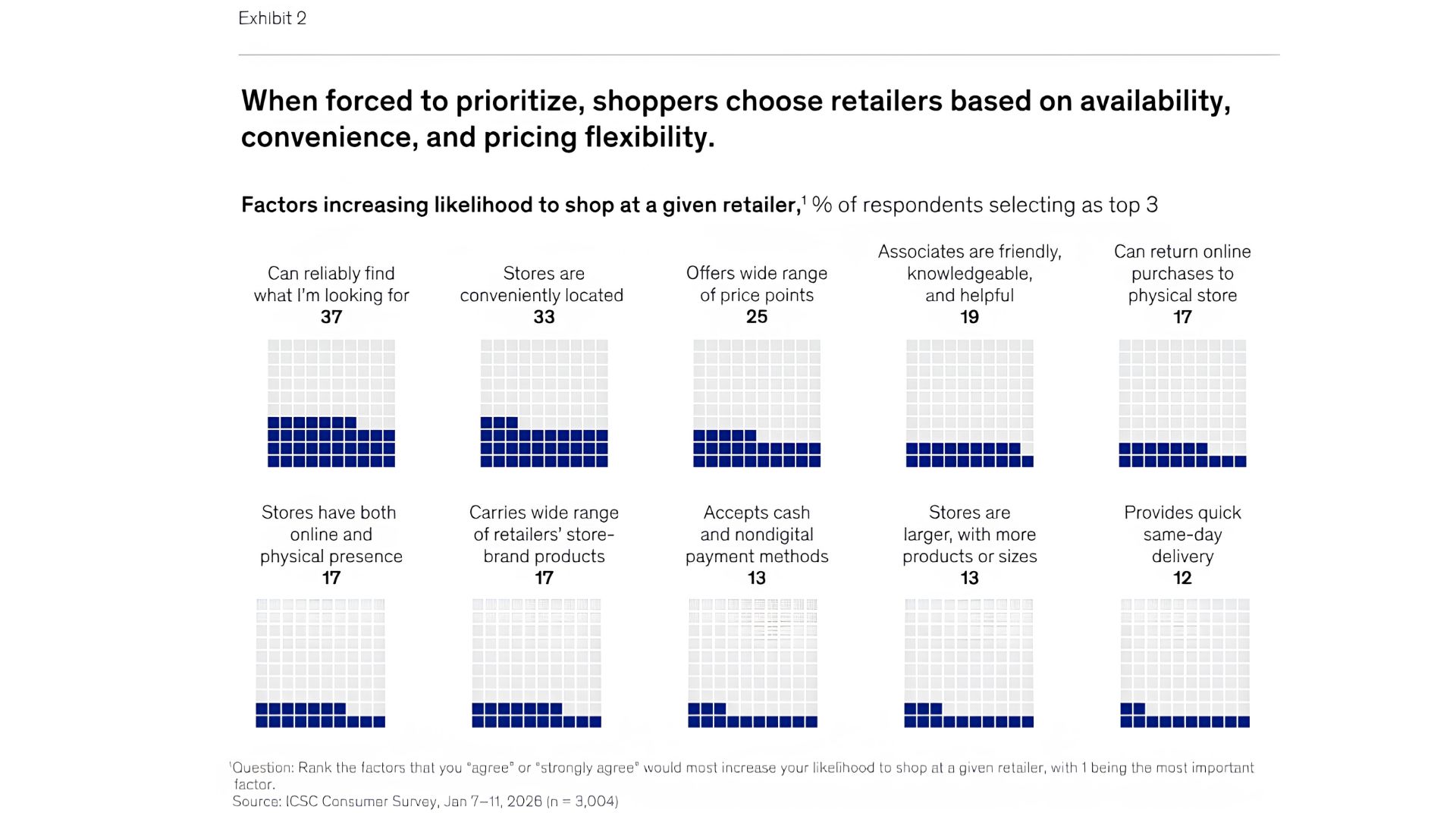
The second force is a rising demand for transparency and frictionless convenience. Modern shoppers expect to know, instantly, whether an item is in stock, how much it costs, and when they can get it. They want checkout to be fast, returns to be simple, and the transition between online browsing and in-store buying to feel seamless. Geography matters too: people increasingly favour stores that sit naturally along their daily routes, rather than requiring a dedicated trip.
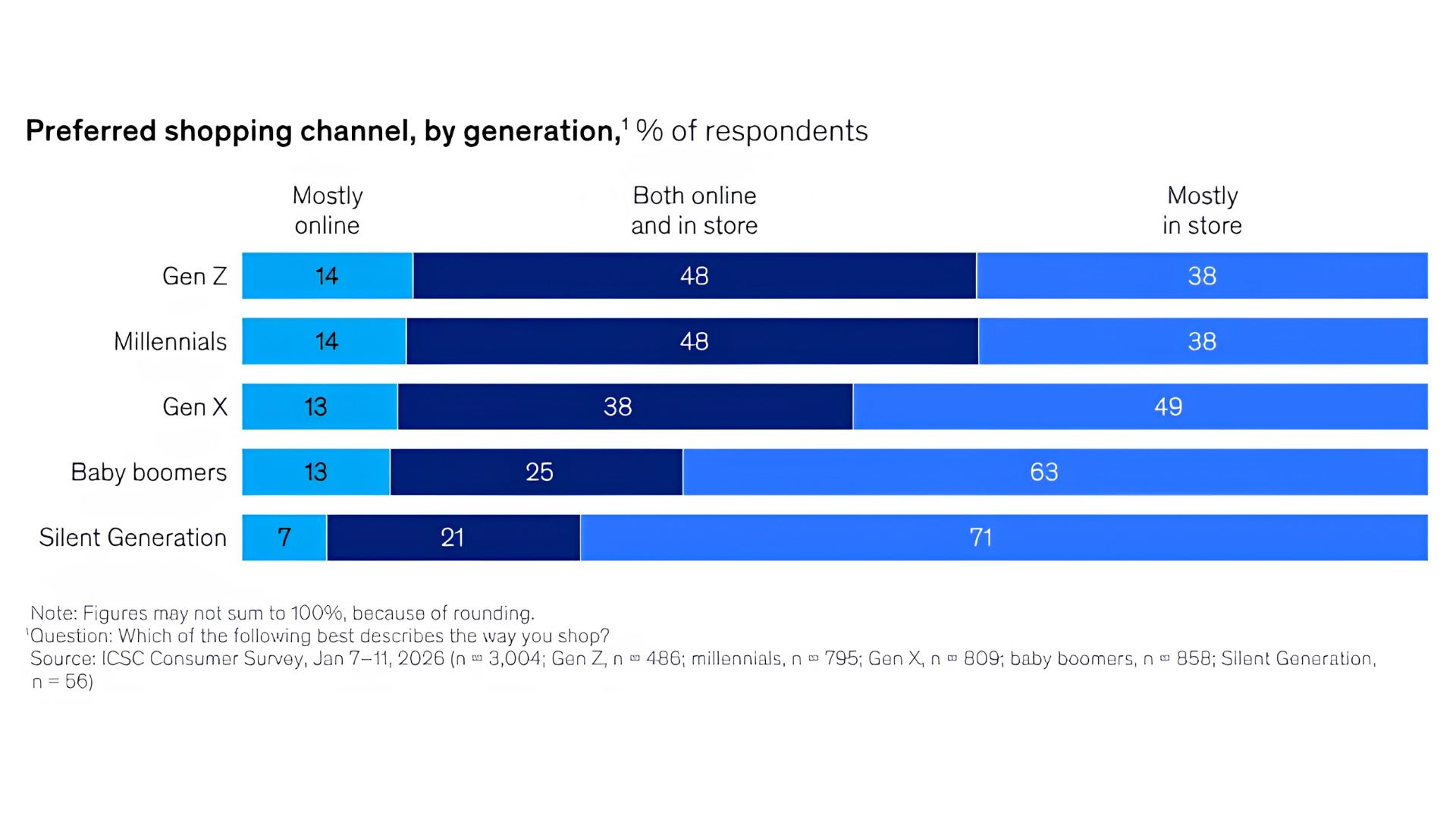
The third force is generational spending power. The expectations of Millennials and Gen Z differ from older shoppers. They are far more comfortable blending online and in-store shopping within a single purchase journey. They gravitate toward retailers with strong digital presences and smooth mobile payment options. And they are more likely to seek out experiential retail, stores that offer something worth showing up for.
Two Reasons Why Consumers Still Walk Into Stores
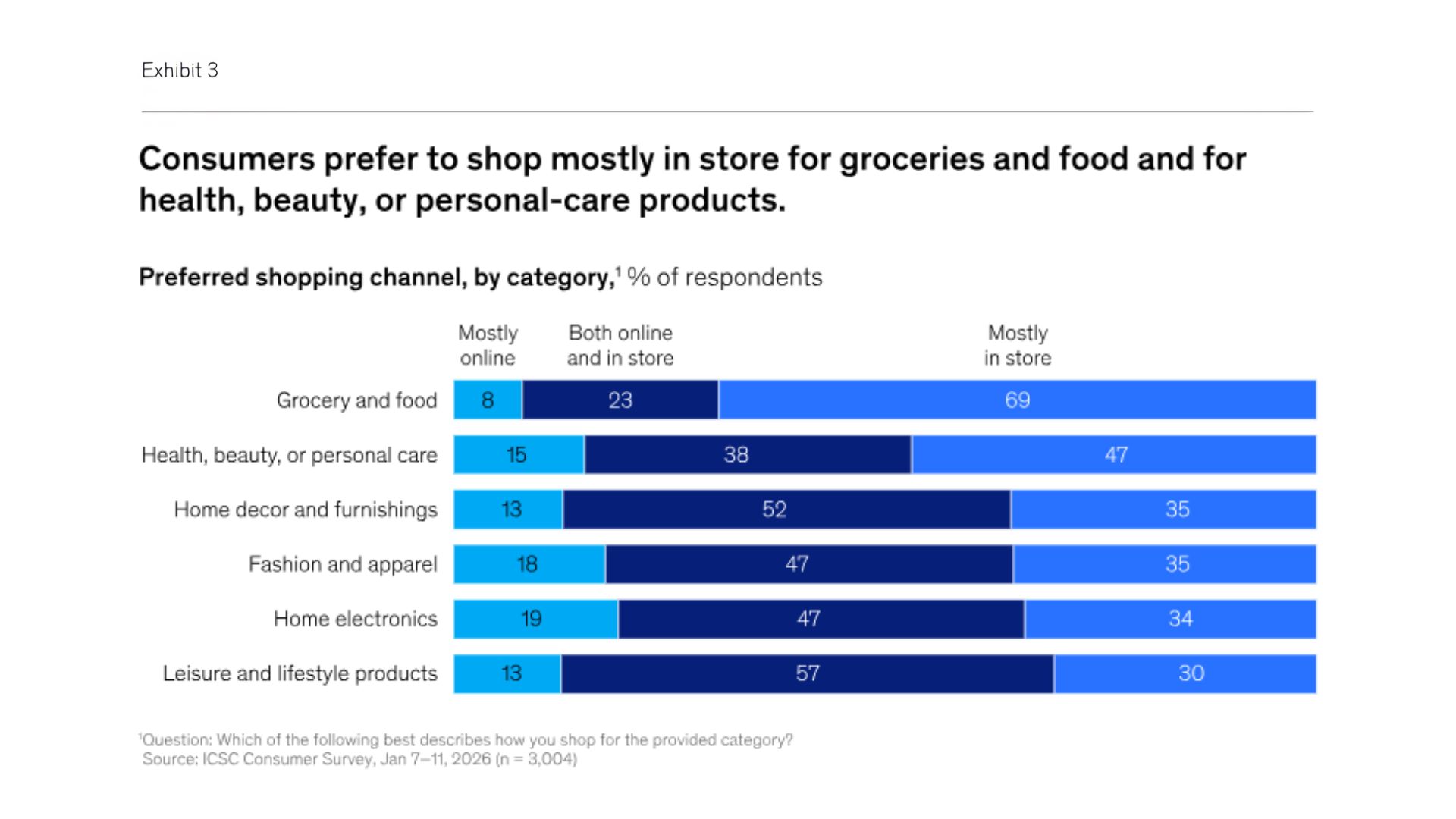
Despite the digital revolution, physical stores are not dying. They are, however, becoming more purposeful. Research consistently shows that shoppers still prefer buying groceries and health or beauty products in person.
Most store trips fall into one of two categories: convenience or discovery.
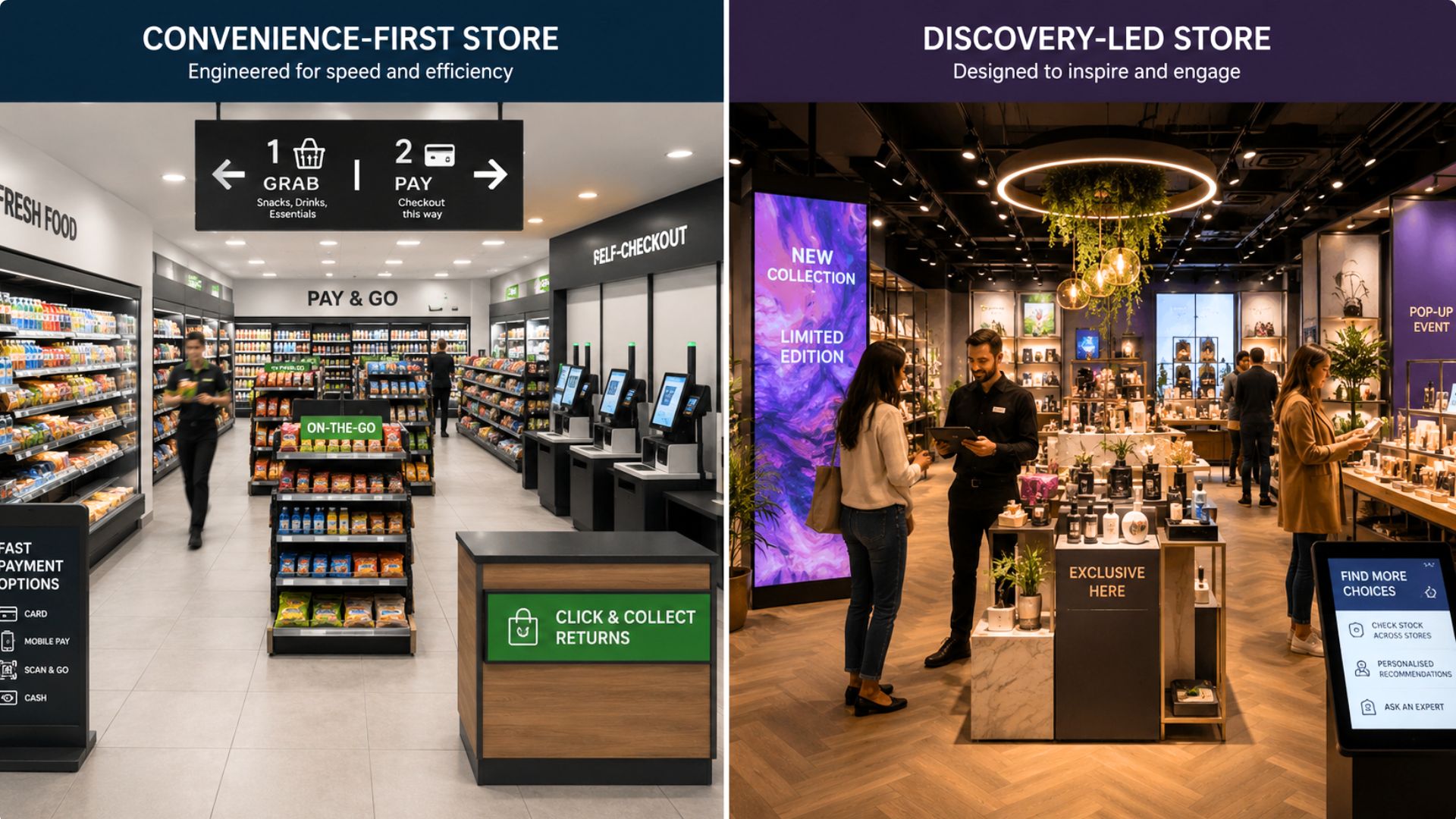
Convenience shoppers arrive knowing exactly what they want. Their priority is speed and reliability: will the product actually be on the shelf? Unclear signage, long queues, and poor stock management are all reasons to switch to a competitor, or simply order online next time.
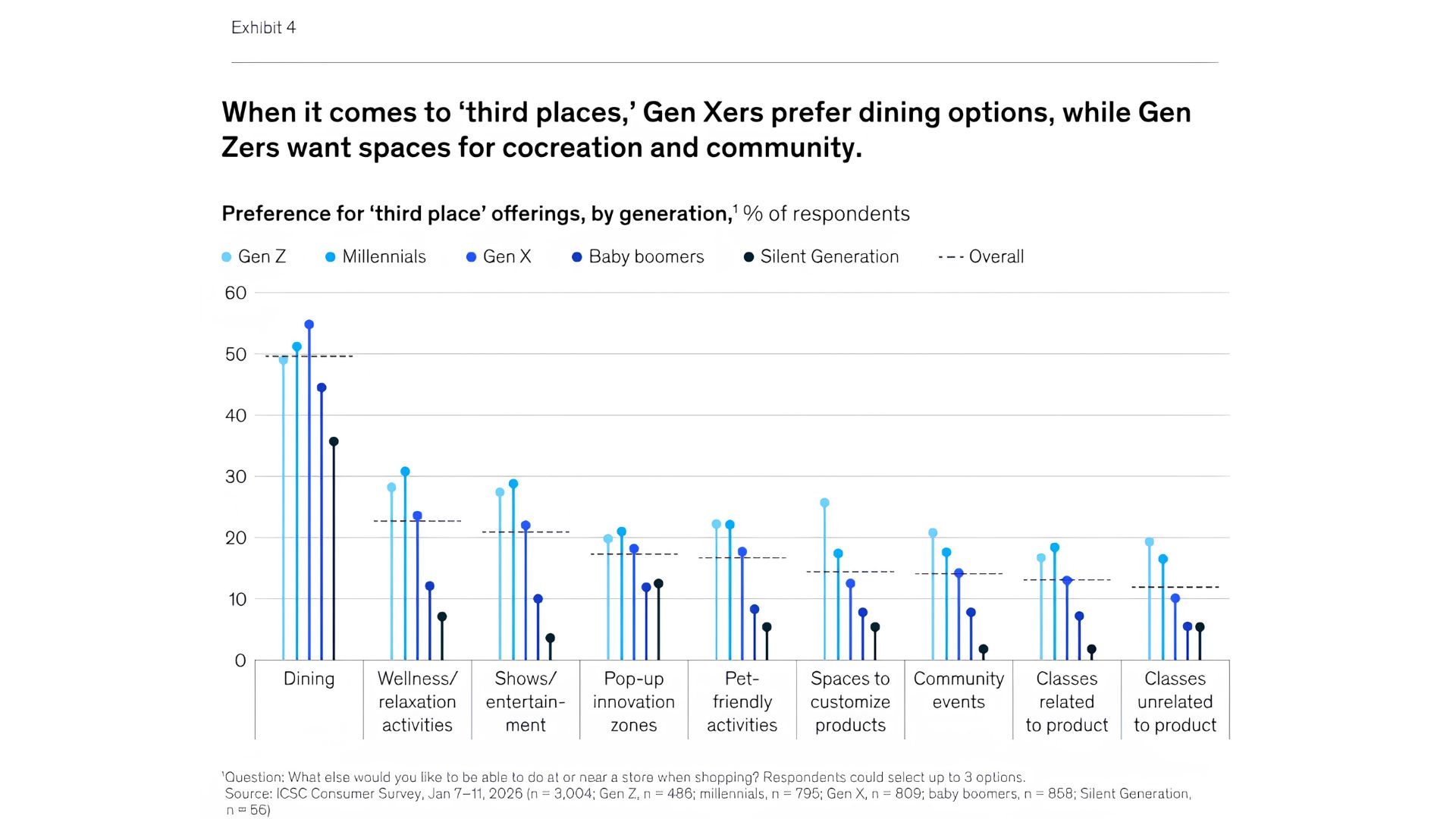
Discovery-driven consumers are drawn by what a screen cannot replicate: the tactile pleasure of engaging with products and the appeal of what researchers call "third places", welcoming spaces outside home and work where people can linger and connect. Shopping destinations that offer this are giving consumers a compelling reason to show up and stay.
Designing Stores Around a Clear Mission
Retailers that define a clear primary mission for each store, and then build everything around that mission, are far better positioned to win.
Convenience-first stores need to be engineered for speed. Short, intuitive paths from entrance to product to checkout, reliable stock levels, multiple fast-payment options (including self-checkout and mobile pay), and well-organised returns areas. Staff in these stores are needed to act as rapid-response helpers. Technology investments should focus on real-time inventory accuracy, AI-driven demand forecasting, and clear, up-to-date pricing across
Discovery-led stores have a different goal: to make time spent in-store feel worthwhile. This means curating compelling product selections, rotating displays, pop-up activations, and exclusive or limited-edition offers that create reasons to visit regularly. Staff play a more consultative role, using digital tools to offer personalised recommendations, check availability across locations, and engage customers in longer conversations. These tools, once the preserve of luxury boutiques, are increasingly accessible to mainstream retailers and represent a meaningful competitive advantage.
A store that tries to serve both convenience and discovery shoppers equally well often ends up serving neither particularly well.
Retailers that continue managing all stores the same way, varying only by size or location, risk building spaces that are mediocre at everything and excellent at nothing. The ones that will win are those that give every store a clear reason to exist, then build everything around that purpose.
1. Each location needs a primary role: convenience hub, discovery destination, or fulfilment node. That mission should dictate the layout, the product range, the staffing model, and the service experience. Crucially, it also means deciding what the store will not do. A convenience store that tries to inspire browsing, or a discovery flagship that rushes customers through, serves no one well. The mission must be visible to the customer and not just to the ops team.
2. Technology investments should follow the store's purpose. In a convenience-led store, the priority is reliability: accurate stock data, live pricing, and AI-driven staffing that matches footfall. In a discovery-led store, technology should deepen the experience, helping customers explore options, check availability, or request assistance without breaking the flow of browsing. The measure of good retail technology is not how advanced it is, but how invisible it feels to the consumer.
3. Different store missions need different people doing different things. Convenience stores need associates who are fast, cross-trained, and ready to solve problems on the move. Discovery stores need specialists - in styling, product knowledge, or experiential service, who are comfortable with longer, more consultative customer interactions. Training, performance expectations, and day-to-day workflows all need to reflect this. The store's promise to the consumer is only as strong as the team delivering it.
Retail's Next Chapter Belongs to Those Who Listen
The consumer has not abandoned physical retail but raised the bar for what makes it worth their while. The stores and destinations that earn a lasting place in people's lives will be those with the sharpest sense of purpose, a clear understanding of why consumers are coming, and designed to deliver on that expectation.
In a world where AI can handle the transactional and the routine, the store's most powerful asset is its humanity: the ability to provide something real, immediate, and genuinely tailored to the person standing in front of it. The retailers and destinations that lean into that truth, and place the consumer genuinely first in every decision, will define what shopping looks like for the decade ahead.
In a world where AI can handle the transactional and the routine, the retail store's most powerful asset is its humanity: the ability to provide something real.
The central insight of McKinsey's 2026 consumer research is not limited to Retail, but can be applied across sectors.

Utilities & Power Distribution
Outages are the utility equivalent of an empty shelf: a single failure erodes loyalty built over years. Zero-tolerance reliability is now the minimum expectation. Consumers expect transparent, real-time consumption data and frictionless billing. Distribution infrastructure that adapts in real time, through technology and smarter grid management, becomes a strategic asset.
Yet technology alone is not enough. As complexity grows, utilities also need a strong human interface: people who can step in when systems fail, guide consumers through high-stakes situations, and provide the kind of reassurance that no app or chatbot can replicate.
FMCG
Shelf availability has always mattered in FMCG; it now matters more. As AI agents auto-replenish grocery baskets, brands must compete for 'share of algorithm'.
Health and beauty is the category consumers most prefer to experience in-store. For beauty products and health brands, this validates investment in experiential retail: sampling, pop-ups, curated environments - alongside digital presence. Gen Z's pull toward discovery and limited-edition drops offers a higher-ROI route to trial than traditional trade spend.

Music & Entertainment
As AI floods markets with generic content, original, emotionally resonant creative IP becomes scarcer and more valuable. The same logic that rewards authentic retail experiences over commodity ones rewards catalogues of original music over algorithmically generated content.
Products positioned as emotional experiences will hold loyalty that streaming services cannot commoditise. Gen Z's preference for co-creation and community points toward participatory formats: live events, artist collaborations, and user-generated engagement layered on top of the core catalogue.

Publishing
What AI is doing to retail, it is also doing to journalism: automating the commodity and raising the bar for everything else. Routine news aggregation and information summaries will be fully automated. Publications that survive will stand for something - original reporting, sharp editorial voice, trusted authority - not just information delivery.
The 'discovery-driven' consumer archetype maps closely to the premium magazine reader: someone not seeking routine information but curation, ideas, and perspectives worth lingering over. This validates investment in editorial quality, events, and community.
Source & Attribution:
This article draws on findings from Shopping in the Age of AI: Redefining Stores for a New Era (April 2026), a report by McKinsey & Company in partnership with ICSC. The research is based on a consumer survey of 3,004 US participants conducted January 7–11, 2026, alongside interviews with retail and real estate executives. All charts (Exhibits 1–4) are reproduced from the original McKinsey report. Full report available at mckinsey.com. Authors: Colleen Baum, Molly Squire, Tyler Rose, and Joshua Reuben.


